For those of us who have worked with NCQA accreditation for decades, it can be surprising to hear a question that is actually quite common:
“We need to become NCQA accredited. Where do we even start?”
Organizations pursuing Population Health Program, Case Management, Case Management with Long-Term Services and Supports, Utilization Management, or Credentialing accreditation may be encountering NCQA for the first time. Physician organizations performing credentialing may also discover that accreditation has become important to their health plan relationships or growth strategy.
The challenge is that accreditation comes with its own language, processes, timelines and expectations. If you have never been through an NCQA survey, it can be difficult to know what you don't know.
Here is where we recommend beginning.
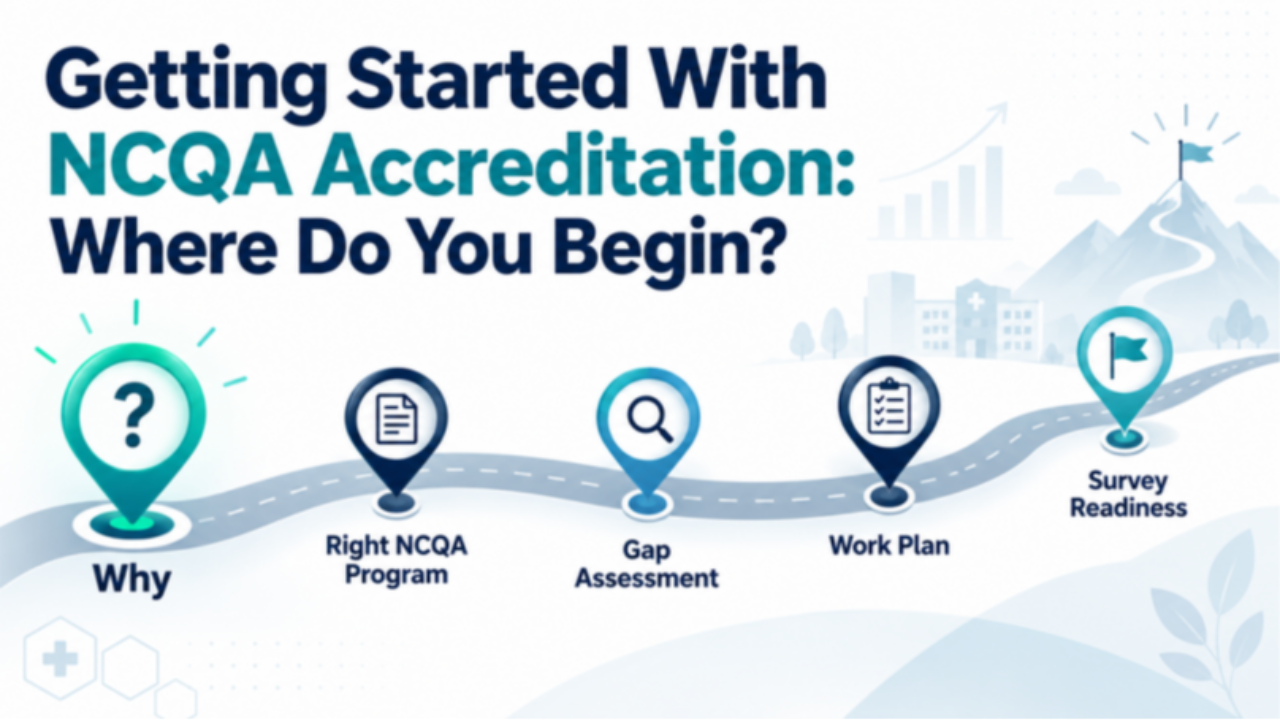
1. Start with Why?
Before purchasing standards or building an accreditation team, determine why your organization is pursuing accreditation.
Is accreditation:
- Important for market credibility or competitive positioning?
- Required by an existing health plan or other customer?
- Appearing increasingly in RFIs and RFPs?
- Necessary for a new contract?
- Part of a strategy to expand into new markets?
- Being pursued because competitors are accredited?
The answer matters because it can help determine both the accreditation program you need and the urgency of your timeline. This is one of the first questions I ask on a Discovery Call because the answer shapes what comes next.
2. Make Sure You Are Pursuing the Right NCQA Program
This sounds obvious. It isn't always.
Organizations frequently come to us knowing they need “NCQA accreditation” without knowing exactly which accreditation program applies to the services they perform.
For example, an organization providing several different services may need to determine whether Population Health Program, Case Management, Utilization Management or another accreditation best aligns with its business model and contractual requirements.
Don't guess.
If you are uncertain which NCQA product is appropriate, contact NCQA Customer Support and describe your organization's services and the reason you are pursuing accreditation. Confirm the appropriate program before making a significant investment in preparation.
3. Give Yourself Enough Time
One of the biggest mistakes first-time organizations make is underestimating how long accreditation preparation takes.
For an organization new to NCQA based on our experience, 12 months should generally be considered a minimum preparation period. Approximately 15 months is considerably more workable, depending upon the organization's existing readiness.
Why so long?
NCQA accreditation is not simply a documentation exercise. Your organization may need to change policies, processes, committee structures, reporting, data collection, monitoring activities and operational practices. Some requirements must be implemented for a specified period before they can be demonstrated as compliant.
A document created shortly before the survey cannot compensate for an operational process that should have been functioning months earlier.
4. Don't Make the Standards Your Only Starting Point
Naturally, you will need the applicable NCQA Standards and Guidelines.
But purchasing the standards and beginning on page one is not necessarily the best way to learn accreditation.
NCQA standards can be nuanced. Requirements may interact with other requirements. There are definitions, explanations, exceptions, scoring implications and documentation expectations that may not be apparent to someone reading the standards for the first time.
Two organizations can read the same requirement and reach very different conclusions about what NCQA expects.
That is one reason experienced accreditation professionals often say:
You don't know what you don't know.
Understanding the words in a standard and understanding how those words are evaluated during an NCQA survey are not necessarily the same thing.
5. Consider Selecting an Experienced Consultant Early
If your organization plans to use an accreditation consultant, don't wait until you are already in trouble to find one. Involve that person early enough to shape the preparation strategy.
Selecting the right consultant can itself take one to three months, particularly if your organization uses a rigorous procurement, contracting or vendor-review process.
Look for consultants with meaningful experience in the specific accreditation you are pursuing. Ask about their survey experience, approach to readiness assessment, availability, tools and resources, project methodology, and how they will transfer knowledge to your internal team.
The goal should not simply be to hire someone who knows the standards. You want expertise that helps your organization understand how the requirements translate into operations and survey readiness.
Managed Healthcare Resources has developed a complimentary resource on how to choose the right accreditation consultant that organizations can use when evaluating potential partners.
6. Identify Who Will Own Accreditation Internally
Even with outside consulting assistance, accreditation cannot be outsourced entirely.
Someone within the organization must have responsibility and authority for moving the initiative forward.
Identify:
- An executive sponsor.
- A primary accreditation/project leader.
- Subject matter experts for applicable functional areas.
- Business and operational owners responsible for implementing required changes.
- Individuals responsible for policies, reports and other documentation.
Accreditation crosses departments. Waiting until late in the process to establish ownership almost always makes preparation more difficult.
7. Conduct a Baseline Gap Assessment Before You Start Rebuilding
A common mistake is immediately rewriting policies, creating committees and developing new reports.
First determine what you already have.
A thorough gap assessment should answer four basic questions:
What already meets NCQA requirements?
What exists but needs modification?
What is missing?
What are we doing operationally that is not adequately documented or demonstrated?
This creates the foundation for your accreditation work plan.
It also prevents an organization from spending valuable time rebuilding processes that may already meet requirements while overlooking more significant deficiencies.
9. Translate the Findings Into an Accreditation Work Plan
Once you understand your gaps, turn them into a structured implementation plan.
Each requirement should have accountability, deliverables and deadlines. High-risk items and requirements needing longer implementation periods should receive priority.
Your plan should also incorporate key NCQA milestones, including application activities, required look-back periods, internal reviews, document quality assurance, submission and file-review preparation.
Think of the survey date as the end point, not the beginning of your planning.
Work backward from it.
What I Would Do in the First 30 Days
If your organization learned today that it needs NCQA accreditation, the first month should be about getting oriented and making good decisions—not frantically writing policies.
During those first 30 days:
- Clarify why accreditation is being pursued and identify any contractual, RFI/RFP or market deadlines driving the decision.
- Confirm the correct NCQA accreditation program. Contact NCQA if there is uncertainty.
- Establish a preliminary target timeframe, recognizing that a first-time organization should generally allow at least 12 months and preferably approximately 15 months for preparation.
- Identify an executive sponsor and internal accreditation leader.
- Obtain the applicable NCQA Standards and Guidelines and begin educating key team members about the accreditation process—not simply individual standards.
- Begin evaluating accreditation consultants, if outside expertise will be used. Allow sufficient time for interviews, due diligence, contracting and onboarding.
- Plan a comprehensive baseline gap assessment before launching major remediation activities.
At the end of those 30 days, you probably won't be “accreditation ready.”
You shouldn't expect to be.
But you should know what accreditation you are pursuing, why you are pursuing it, who is responsible, when you intend to be surveyed, what expertise you need, and how you will determine your current state of readiness.
That is a much better place to be.
Accreditation Is a Process, Not an Event
One of the most important concepts for an organization new to NCQA is that accreditation isn't something you prepare for shortly before the survey.
Accreditation requirements become part of how the organization operates.
Policies need to reflect practice. Processes need to be implemented consistently. Monitoring needs to occur. Files need to demonstrate compliance. Required data need to be collected and analyzed. And evidence needs to be available when the survey occurs.
That is why beginning correctly matters so much.
Organizations that start by asking, “What documents do we need for the survey?” may already be asking the wrong question.
A better question is:
“What do we need to put in place now so that, when our survey occurs, we can demonstrate that we have been operating in accordance with NCQA requirements?”
That shift in thinking is the beginning of accreditation readiness.
And if you're new to NCQA and aren't quite sure where to start, that's precisely when experienced guidance can provide the greatest value—before time and resources are invested in the wrong direction.
New to NCQA accreditation? Start with our free guide on selecting the right accreditation consultant, or schedule a complimentary discovery call to discuss your organization's accreditation goals.


