Organizations pursuing URAC accreditation often focus on selecting the right accreditation program—but selecting the right consulting partner can have just as much impact on the outcome.
A knowledgeable consultant can help your organization navigate complex standards, avoid unnecessary work, identify compliance gaps early, and build sustainable processes that continue long after the survey is complete. Conversely, choosing the wrong consultant can result in missed requirements, unnecessary expense, staff frustration, and even accreditation delays.
If your organization is evaluating consulting firms, here are the most important factors to consider before making your decision.
1. Verify Actual URAC Experience
Not all healthcare consultants are URAC consultants.
Some firms provide general healthcare consulting and only occasionally assist with accreditation. Others specialize in accreditation but have limited experience with the specific URAC program you are pursuing.
Ask questions such as:
- How many URAC surveys has the consultant supported?
- Which URAC accreditation programs have they worked with?
- How recently have they completed projects?
- Can they provide references from organizations similar to yours?
Healthcare organizations differ significantly in structure and operations. Experience with a pharmacy organization may not translate directly to telehealth, case management, utilization management, or independent review organizations.
The consultant should understand not only the standards, but also how those standards are applied within your specific operational environment.
2. Look for Current Knowledge
Healthcare accreditation is continuously evolving.
Standards are updated. Interpretations change. Frequently Asked Questions (FAQs) clarify expectations. Survey trends shift over time.
Your consultant should remain actively engaged in accreditation work and maintain current knowledge of:
- New standards
- Interpretive guidance
- Frequently missed requirements
- Common survey findings
- Industry best practices
Ask how the consultant stays current between accreditation cycles.
3. Ask About Survey Experience
There is a meaningful difference between understanding written standards and understanding how surveys are actually conducted.
Consultants with survey experience—or extensive experience preparing organizations that successfully complete surveys—often provide practical insights that go beyond simply reading the standards.
They understand:
- Documentation expectations
- Interview preparation
- File review methodology
- Survey logistics
- Common areas where organizations struggle
This perspective helps organizations prepare more efficiently and with greater confidence.
4. Evaluate Their Gap Assessment Process
One of the most valuable services a consultant provides is identifying compliance gaps before URAC does.
Ask prospective consultants:
- How do they conduct a gap analysis?
- How detailed are their findings?
- Will they prioritize recommendations?
- Will they distinguish between required changes and optional best practices?
- Will they explain the rationale behind each recommendation?
A useful gap assessment should become a roadmap—not simply a list of deficiencies.
5. Make Sure They Teach, Not Just Tell
The best consultants don’t simply provide answers.
They help your staff understand the “why” behind the standards.
Organizations benefit most when consultants:
- Explain intent behind requirements
- Coach staff during implementation
- Build internal knowledge
- Develop organizational confidence
- Reduce dependence on outside consultants over time
Accreditation should strengthen your organization—not create permanent reliance on external expertise.
6. Ask About Practical Implementation Experience
Knowing the standards is only part of the job.
Can the consultant help your team implement workable processes?
Strong consultants understand operations as well as compliance.
They should be able to discuss:
- Workflow design
- Policy development
- Committee structure
- Performance measurement
- Documentation practices
- Quality improvement
- Staff education
The goal is operational excellence—not simply passing a survey.
7. Understand Their Project Management Approach
URAC accreditation involves multiple departments working toward a common goal.
Without effective project management, organizations often experience:
- Missed deadlines
- Duplicate work
- Conflicting interpretations
- Staff confusion
- Last-minute document preparation
Ask how the consultant manages projects.
Look for firms that provide:
- Detailed work plans
- Timelines
- Accountability tracking
- Regular status meetings
- Executive reporting
- Risk identification
Successful accreditation depends on disciplined project management as much as technical expertise.
8. Determine Whether They Customize Their Approach
Every healthcare organization is different.
A consultant should understand your:
- Organizational structure
- Size
- Products
- Delegated activities
- Regulatory environment
- Existing quality program
- Available resources
Be cautious of firms that appear to use identical templates and recommendations for every client.
The best consulting engagements are tailored to the organization’s unique needs while still maintaining consistency with URAC requirements.
9. Ask Who Will Actually Perform the Work
During the sales process, many firms introduce senior leaders with extensive experience.
After the contract is signed, day-to-day work may be assigned to less experienced consultants.
Ask:
- Who will lead the engagement?
- Who will perform the work?
- How much experience does each team member have?
- Will senior consultants remain involved throughout the project?
Understanding the delivery team helps avoid surprises later.
10. Look Beyond Survey Day
Accreditation should not be viewed as a one-time project.
Organizations benefit most when consultants help establish sustainable systems that support ongoing compliance between accreditation cycles.
Ask whether the consultant provides guidance on:
- Governance
- Continuous monitoring
- Annual work plans
- Performance measurement
- Staff education
- Readiness assessments
- Accreditation sustainment
Building sustainable processes often reduces future consulting costs while improving organizational performance.
Questions Every Organization Should Ask Before Hiring a URAC Consultant
Before signing a consulting agreement, consider asking:
- How many organizations similar to ours have you supported?
- What is your methodology for preparing clients?
- How do you identify and prioritize compliance gaps?
- What project management tools do you provide?
- How do you prepare staff for interviews?
- What happens if new guidance is released during our project?
- Will you help us sustain compliance after accreditation?
- Who will actually be assigned to our engagement?
- How do you measure project success?
- Can you provide client references?
The answers often reveal far more than a marketing brochure.
Know what to ask before you choose a URAC consultant.
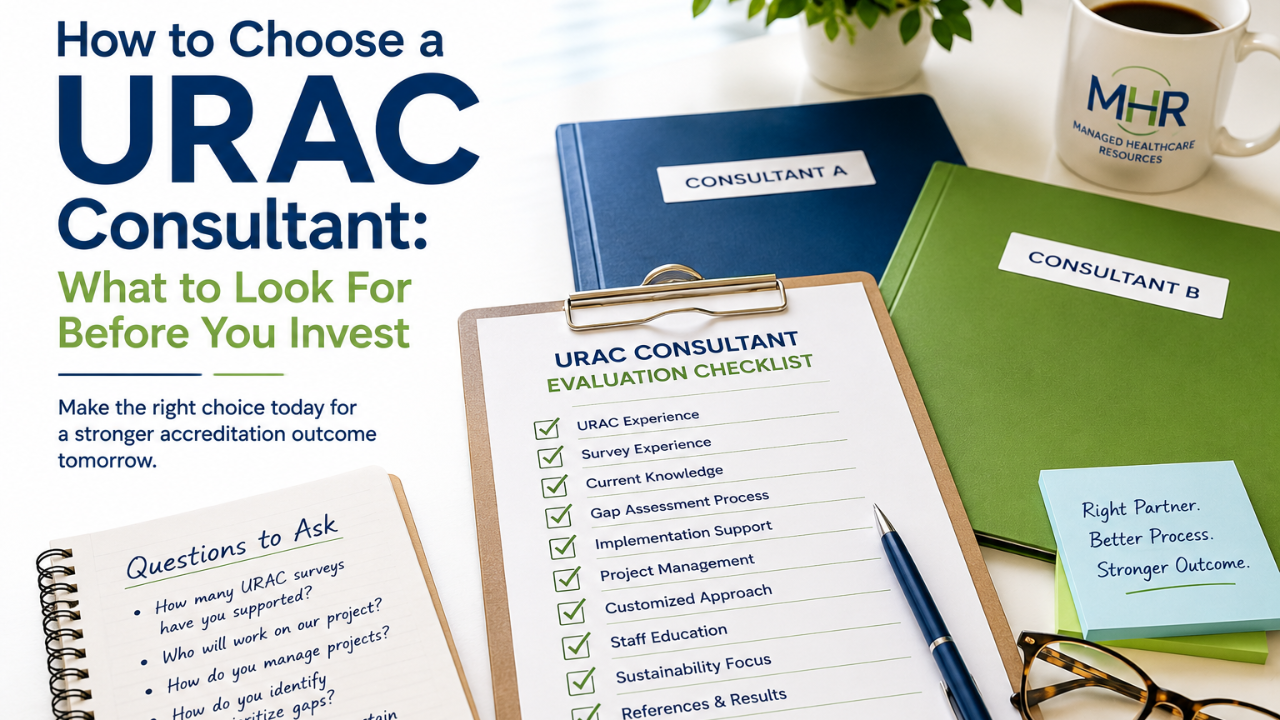
Download our free fillable checklist to evaluate each firm’s URAC experience, implementation support, project approach, fees, deliverables, and overall fit
Choosing a Partner—Not Just a Consultant
URAC accreditation requires collaboration across your entire organization. The right consultant becomes more than a technical advisor—they become a trusted partner who helps your team understand the standards, improve operations, and build confidence throughout the accreditation journey.
Organizations should seek consultants who combine deep accreditation expertise with practical operational knowledge, structured project management, and a commitment to transferring knowledge to internal staff.
The goal is not simply to earn accreditation. It is to build processes that continue delivering value long after the survey has ended.
At Managed Healthcare Resources (MHR), we believe the best consulting relationships are built on partnership, education, and sustainability. Our objective is not merely to help organizations achieve URAC accreditation, but to strengthen the systems, processes, and people that support long-term success.
Choosing the right consulting partner is one of the most important decisions you'll make.
Schedule a discovery call with MHR to discuss your goals and learn how our collaborative approach helps organizations build lasting accreditation success: https://zc.vg/2wWmh or email us [email protected].
Copyright © 2026 Managed Healthcare Resources, Inc. All Rights Reserved.


