Healthcare organizations today face increasing expectations from regulators, employers, health plans, providers, and members. Demonstrating quality is no longer optional—it is a competitive necessity.
For more than three decades, NCQA Accreditation has been one of the most widely recognized indicators that an organization has established rigorous processes to deliver safe, high-quality healthcare. In 2026, however, accreditation represents much more than simply passing a survey. It has become a framework for operational excellence, continuous quality improvement, and organizational credibility.
What Is NCQA Accreditation?
The National Committee for Quality Assurance (NCQA) is an independent, nonprofit organization founded in 1990 to improve healthcare quality through evidence-based standards and objective evaluation of healthcare organizations.
NCQA develops accreditation and certification programs for a broad range of healthcare organizations, including:
- Health Plans
- Behavioral Health Organizations
- Utilization Management Organizations
- Credentialing Organizations
- Provider Networks
- Population Health Management Organizations
- Health Equity Accreditation
- Long-Term Services and Supports (LTSS)
- Health Outcomes and Community-Focused Care
- Patient-Centered Medical Homes (PCMH)
- And numerous additional specialty programs
Each program evaluates whether an organization consistently follows evidence-based practices designed to improve quality, patient safety, member experience, and operational effectiveness.
Accreditation is not simply a documentation exercise. Organizations must demonstrate that policies are operationalized, processes are consistently followed, and outcomes are routinely measured and improved.
Why NCQA Matters More Than Ever in 2026
Healthcare has become increasingly complex.
Organizations must manage rising medical costs, increasing regulatory scrutiny, workforce shortages, cybersecurity risks, artificial intelligence, health equity initiatives, and growing expectations for measurable outcomes.
NCQA standards continue to evolve alongside these challenges.
For surveys effective July 1, 2026, organizations must pay increasing attention to areas including:
- Governance and organizational accountability
- Quality measurement and continuous improvement
- Delegation oversight
- Population health management
- Member experience
- Health equity
- Responsible use and oversight of artificial intelligence
- Cybersecurity-related reportable events
- Ongoing compliance after accreditation is awarded
Today’s accreditation is designed to evaluate how well organizations actually operate—not simply whether policies exist.
Accreditation Is No Longer Just About Compliance
Many organizations initially pursue NCQA Accreditation because it is required.
State Medicaid agencies, commercial health plans, employer purchasers, and government programs may require accreditation as a condition of participation or contracting.
While those requirements remain important, leading organizations increasingly view accreditation differently.
NCQA standards provide a proven management framework that helps organizations:
- Standardize operations
- Reduce variation
- Improve quality oversight
- Strengthen governance
- Improve regulatory readiness
- Reduce operational risk
- Demonstrate accountability to clients and regulators
Organizations that fully embrace the standards often discover improvements extending well beyond survey preparation.
Accreditation Creates Competitive Advantage
Healthcare purchasers have more choices than ever.
When competing for contracts, responding to RFPs, or pursuing new partnerships, accreditation provides independent validation that an organization has implemented nationally recognized quality standards.
NCQA Accreditation communicates that an organization has invested in:
- Clinical quality
- Member safety
- Regulatory compliance
- Data-driven decision making
- Continuous improvement
- Organizational accountability
For many prospective clients, accreditation reduces uncertainty because an independent third party has evaluated the organization’s operations.
2026: Greater Focus on Continuous Compliance
One misconception is that accreditation ends once the survey is complete.
In reality, organizations are expected to maintain compliance throughout the accreditation cycle.
Current NCQA policies require organizations to:
- Report significant reportable events within required timeframes.
- Complete annual attestations.
- Continue meeting accreditation requirements after survey completion.
- Cooperate with investigations or discretionary surveys when necessary.
- Maintain readiness rather than preparing only every three years.
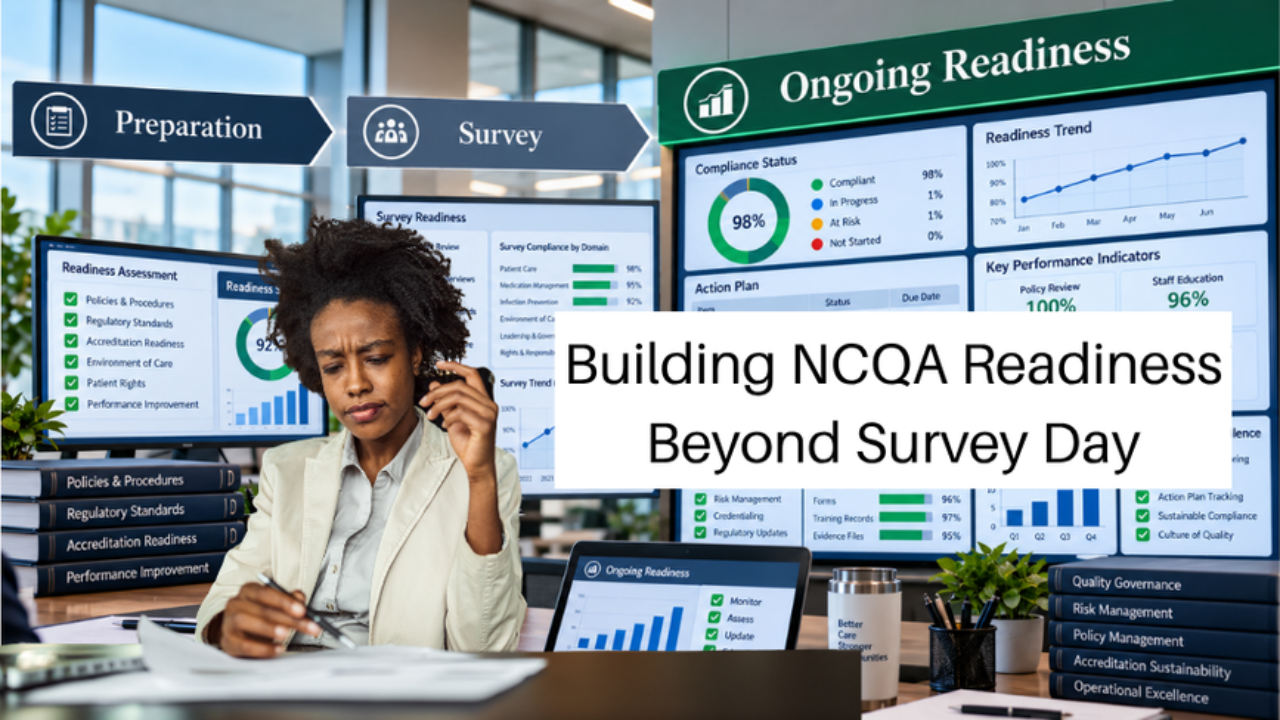
Successful organizations increasingly shift from “survey preparation” to an ongoing accreditation management model.
Common Misconceptions About NCQA Accreditation
“It’s just paperwork.”
Documentation is only one component.
Surveyors evaluate whether documentation accurately reflects actual operational practices. Many standards include file reviews, interviews, performance measurement, and evidence that processes are consistently implemented.
“Once we’re accredited, we’re finished.”
Accreditation represents the beginning—not the end—of continuous quality improvement.
Organizations are expected to sustain compliance throughout the accreditation period.
“It’s only valuable for health plans.”
While Health Plan Accreditation is widely recognized, NCQA now offers accreditation and certification programs for many different healthcare organizations, reflecting the growing complexity of healthcare delivery.
The Value of Experienced Guidance
Preparing for NCQA Accreditation requires more than reading the standards.
Organizations must understand:
- The intent behind each requirement
- Acceptable evidence
- Common scoring pitfalls
- Documentation expectations
- File review methodology
- Surveyor expectations
- Recent policy updates and FAQs
Experienced consultants can often identify risks early, helping organizations avoid costly delays, corrective action plans, or missed opportunities for higher scores.
The goal should never be to “check the box.”
The goal is to build sustainable processes that continue delivering value long after the survey concludes.
Final Thoughts
In 2026, NCQA Accreditation has become much more than a compliance exercise.
It is a nationally recognized demonstration of organizational quality, operational maturity, and commitment to continuous improvement.
Organizations that approach accreditation strategically often strengthen governance, improve operational consistency, reduce risk, and position themselves more competitively in the marketplace.
The most successful organizations don’t prepare for accreditation every three years.
They build systems that allow them to remain survey-ready every day.
How Ready Is Your Organization for NCQA Accreditation?
NCQA Accreditation requires more than strong policies. Organizations need consistent operational practices, engaged leadership, prepared staff, reliable documentation, and ongoing monitoring.
Not sure where your organization stands?
Start with MHR’s NCQA Accreditation Readiness Self-Assessment.
Answer 25 questions covering leadership, planning, operational processes, staff readiness, file reviews, and overall accreditation readiness to identify areas that may need additional attention.
Take the NCQA Accreditation Readiness Self-Assessment
If your results uncover gaps, or you want an experienced perspective before moving forward, MHR can help you evaluate your readiness, clarify priorities, and determine the next steps for your accreditation journey.
About Managed Healthcare Resources
Since 1991, Managed Healthcare Resources (MHR) has helped healthcare organizations successfully prepare for NCQA Accreditation across virtually every accreditation product. Our consultants include former and current NCQA surveyors and experienced healthcare leaders who understand not only what the standards require, but the intent behind them. We help organizations build sustainable compliance—not simply prepare for survey day.


