Navigating Mergers, Acquisitions & Consolidations: Your Complete Roadmap to Maintaining NCQA Accreditation
Sep 13, 2026
A practical guide to NCQA’s 2026 Merger, Acquisition and Consolidation (MAC) Policy for compliance teams
It seems that 2026 and 2027 are the years of mergers, acquisitions and consolidations. If your organization is involved in a merger, acquisition, consolidation, or corporate reorganization, one of your most critical compliance obligations is managing the impact on your NCQA accreditation. NCQA’s Merger, Acquisition and Consolidation (MAC) Policy governs exactly that—and understanding it can mean the difference between a smooth transition and losing your accreditation status.
This guide breaks down everything you need to know: when to notify NCQA, what triggers a MAC Survey, how accreditation status is determined post-merger, and what to prepare if a survey is required.
Step 1: Understand the Scope — Does the MAC Policy Apply?
Definitions: The MAC Policy applies to all NCQA-accredited health plans involved in:
- Mergers — combination of two or more legal entities into one
- Acquisitions — purchase or transfer of at least 50% ownership or control, or transfer of a health plan’s assets/members
- Consolidations — complete or partial combination of functions across accreditable entities owned by one legal entity
- Reorganizations — reordering or altering the corporate structure, including creating or dissolving an entity
NCQA treats all of these scenarios the same under the MAC Policy. The key question is whether the transaction changes the legal or operational structure of the accredited organization.

Step 2: Send Written Notice to NCQA — Within 30 Days
This is your first and most time-sensitive obligation. Any NCQA-accredited organization involved in a covered transaction must submit written notice to NCQA.
Timing
Submit notice within 30 calendar days of the merger, acquisition, consolidation, or reorganization date—or earlier if possible.

Although formal written notice is required after the transaction closes, NCQA encourages organizations to discuss pending transactions in advance. Early conversations help you understand potential impacts on accreditation status and survey scheduling before the deal is done.
What Your Written Notice Must Include
Many times the legal department is primarily involved as you can see how many of the bullet points will involve them.
Your notice should outline the nature of the transaction as completely as possible.
Required content includes:
- Names of all legal entities involved and their NCQA accreditation status
- Brief description of the transaction and any available documentation (e.g., press releases, Articles of Merger, Bill of Sale, Assignment Agreement)
- Number of members affected
- Projected timelines for merger and consolidation activities
- Service areas covered
- Board and committee structures
- Licensure information
- Areas of consolidation
- Significant structural or staffing changes
- Changes to practitioner and provider networks
- How products or product lines will be marketed post-merger
If some transaction details are not finalized at the time of notice, provide preliminary expectations and a timeline for when each item will be confirmed.
Step 3: Understand NCQA’s Initial Assessment — What Happens Next
Once NCQA receives your notice, it conducts an initial assessment of the transaction’s impact on accreditation status and scoring. NCQA evaluates member data, current accreditation status levels, expiration dates, and standard scores of all organizations involved.
Based on this assessment, NCQA will determine one of three paths:
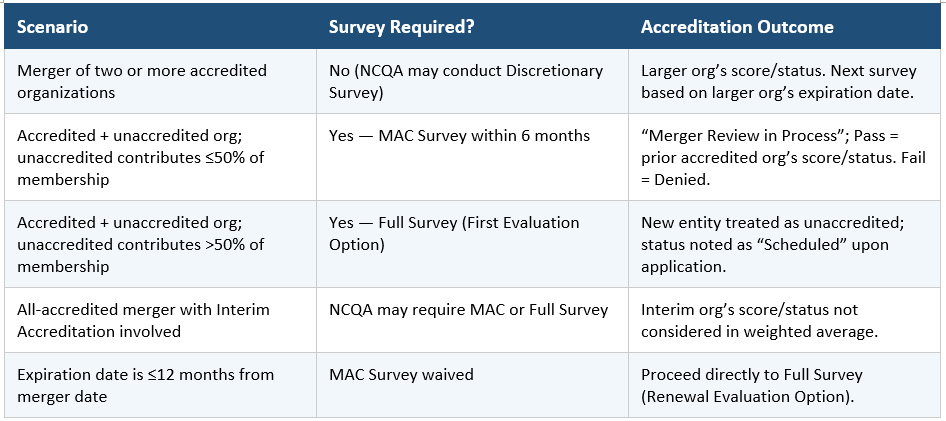
Path A: No Survey Required
If the merger involves only NCQA-accredited organizations, no MAC Survey is required. NCQA uses the larger organization’s expiration date for the next Full Survey, and the new entity’s score and status are based on the largest organization involved.

Path B: MAC Survey Required
A MAC Survey is required when an accredited organization merges with an organization that is:
- Not accredited, AND
- The unaccredited organization contributes 50% or less of the total merged membership
NCQA may also require a MAC Survey to evaluate changes in operational structure to the accreditable entity or to evaluate a new entity resulting from the merger.
During the MAC Survey review period, the new entity’s accreditation status on NCQA’s public report card (reportcards.NCQA.org) is noted as “Merger Review in Process.”
Path C: New Entity is Unaccredited — Full Survey Required
If the unaccredited organization contributes more than 50% of the total merged membership, NCQA considers the result a new, unaccredited entity. To regain accreditation, the new entity must apply under the First Evaluation Option, with its status noted as “Scheduled.”
Step 4: Know the MAC Survey Timeline and Stakes
Survey Timing
If a MAC Survey is required, it must be completed within 6 months of the merger date. The new or surviving entity must also undergo a Full Survey under the Renewal Evaluation Option on or before the expiration date of the accredited organization involved in the merger.

Serial Mergers
Organizations that merge or consolidate in stages over time are examined by NCQA on a case-by-case basis. A 6-month look-back period applies to each transaction to determine if a serial merger or consolidation situation exists and what type of survey may be necessary.
What’s at Stake
The accreditation consequences are significant. If the new entity passes the MAC Survey (or NCQA waives it), the score and status are based on the accredited organization’s existing score. If the entity fails, it receives Denied Accreditation status. An organization that refuses to undergo a required MAC Survey or Full Survey loses its accreditation status.
Step 5: Prepare for the MAC Survey
What the Survey Covers
The MAC Survey reviews a subset of Health Plan Accreditation standards—not the full set. It includes:
- A review of the organization’s description of changes to the accreditable entity and/or the new entity
- A timetable for reporting HEDIS results based on merged/consolidated product lines and products
- For organizations accredited under the First or Renewal Evaluation Option: an onsite review for continued compliance with accreditation standards
- File review of complex case management, UM, and credentialing processes
File review covers case management files, UM denials, UM appeals, and credentialing files. NCQA randomly selects files reflecting activities from the time of the merger or consolidation. Standards in effect at the time of the merger are used.
Standards Reviewed (MAC Survey Tables 1–4)
The MAC Survey evaluates a defined subset of standards across four categories:
Table 1: Core Health Plan Standards
Quality Management and Improvement (QI 1): Program structure, annual work plan, annual evaluation, QI committee responsibilities, and trainings to improve care or service delivery.
Population Health Management (PHM 5): Complex case management systems, case management process, initial assessment, and ongoing management.
Utilization Management (UM 1–9, 11): Program structure and description, clinical criteria, appropriate professionals for UM decisions, timeliness of UM decisions, clinical information, denial notices, appeals policies and handling, and UM information integrity.
Credentialing and Recredentialing (CR 1–5, 8): Credentialing policies and practitioner rights, credentialing committee, verification, recredentialing cycle length, ongoing monitoring and interventions, and information integrity.
Table 2: LTSS Distinction Standards
Long-Term Services and Supports (LTSS 1): Program description, service authorization, notification, demographic data collection, privacy protections, assessments, person-centered care planning process, and implementation.
Care Transitions (LTSS 3): Process for transitions of care.
Table 3: Medicaid Standards
Practitioner office site quality (MED 3), informing members about the QI Program (MED 8D), UM denial notifications and related coverage elements (MED 9), and grievances and appeals policies and processes (MED 10).
Table 4: MA Special Needs Plans Standards
Enrollment verification (SNP 1), assessing and coordinating care (SNP 2), and plan performance monitoring and evaluation of the Model of Care (SNP 3).
Step 6: Gather Required Documentation
To demonstrate compliance during the MAC Survey, the new entity must provide relevant documentation. You have flexibility in how you demonstrate compliance:
Option A: Submit new documents showing policies for the merged health plan.
Option B: Submit premerger documents still in effect, along with a plan for creating policies and procedures for the new entity.
At a minimum, be prepared to submit the following:
- QI program description
- QI work plan
- QI Committee structure and meeting minutes
- UM program description and policies
- UM appeals policies and procedures
- Credentialing (CR) policies, procedures, and committee meeting minutes
- Complex case management policies and procedures
- HEDIS reports and a description of HEDIS reporting systems (Renewal Evaluation Option organizations only)
Step 7: Understand HEDIS Reporting Requirements Post-Merger
For organizations accredited under the Renewal Evaluation Option, before the new entity’s next Full Survey, you may either:
- Submit separate HEDIS results for all previously accredited product lines and products of the new entity, OR
- Submit combined HEDIS results
At the new entity’s next Full Survey, it must submit HEDIS data reflecting care and service provided by the merged or completely consolidated product lines and products. Submission of combined HEDIS data is required only if the complete consolidation resulted in one accreditable entity.
Step 8: Understand MAC Survey Scoring
MAC Surveys use a pass/fail scoring methodology. To pass, the new entity must earn 80% of the applicable points for each standard category.
The Review Oversight Committee (ROC) makes the final accreditation determination. Quantitative ratings are used as an internal tool by NCQA and are based on professional judgment and the organization’s numerical score.
Quick Reference: MAC Policy Decision Map
How can MHR help? We have been used by several of our clients to help frame the documentation and to identify key areas to provide to NCQA so they have an accurate picture of what is anticipated to occur, along with sitting in on calls with the SIG representative to “translate” what NCQA is looking for so the appropriate and correct documentation can be provided and highlight key points.
Final Checklist: Your MAC Policy Action Plan
Use this checklist to ensure you stay on track when a transaction occurs:
- Identify all entities involved and confirm each one’s NCQA accreditation status
- Determine transaction type (merger, acquisition, consolidation, reorganization)
- Engage NCQA early — discuss the pending transaction before it closes
- Submit written notice to [email protected] within 30 days of the transaction date
- Include all required notice content; flag any items not yet finalized
- Await NCQA’s initial assessment and survey determination
- If MAC Survey is required: prepare documentation and schedule within 6 months
- Review standards in Tables 1–4 and assess compliance gaps
- Decide documentation approach: new policies, premerger policies, or transition plan
- Plan HEDIS reporting strategy for merged product lines
- Prepare for MAC Survey scoring: 80% pass threshold per standard category
- Confirm Full Survey schedule aligned with accreditation expiration date
Preparing for a merger, acquisition, or organizational change?
Before you submit your notice to NCQA, MHR can review your planned changes, supporting documentation, and potential accreditation impacts to help ensure NCQA receives a clear and accurate picture of your organization.
Talk with MHR about your MAC documentation and accreditation readiness. Send us a note here: [email protected]
Source: NCQA Health Plan Accreditation 2026, Appendix 3: Merger, Acquisition and Consolidation Policy


