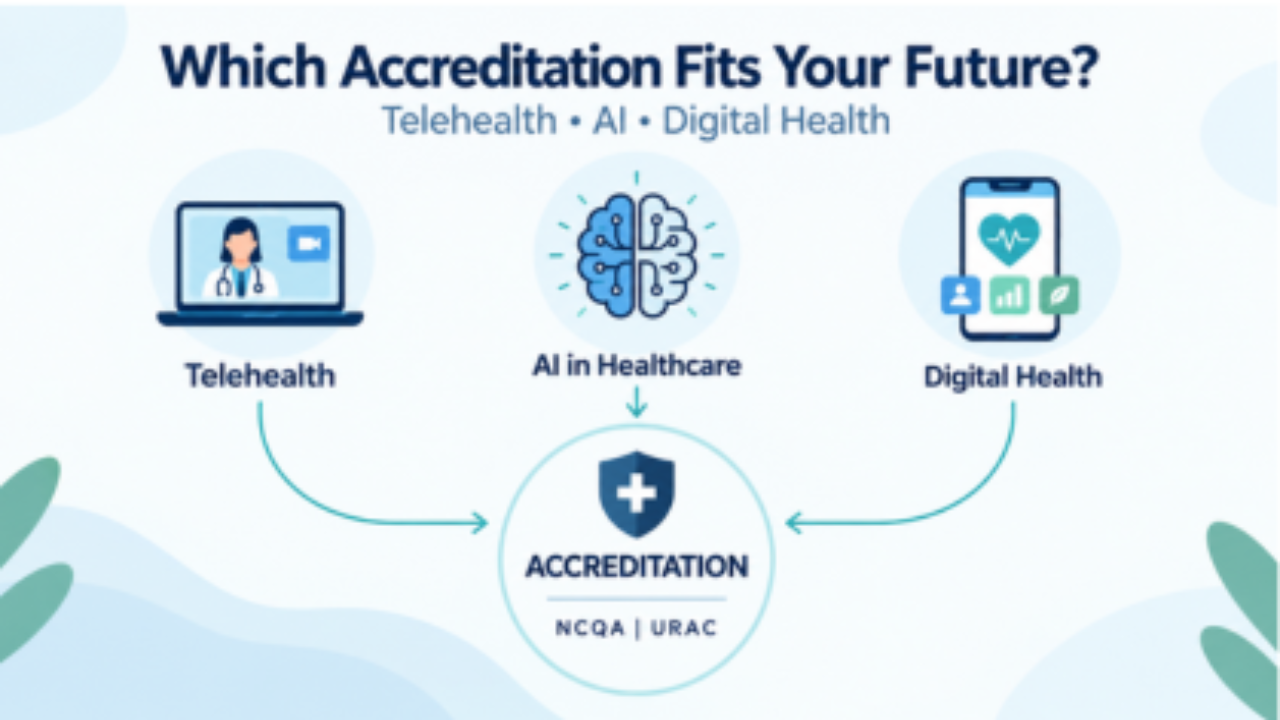
Healthcare is changing rapidly. Is your accreditation strategy keeping pace?
Not long ago, healthcare accreditation decisions were relatively straightforward. Most organizations evaluated accreditation based on whether they were a health plan, behavioral health organization, credentialing entity, or utilization management organization.
Today, the healthcare landscape looks dramatically different.
Organizations are delivering care through virtual platforms, using artificial intelligence to support clinical decision-making, managing patients remotely through connected devices, coordinating specialty pharmacy services, and developing digital tools that didn’t exist just a few years ago.
As healthcare evolves, accreditation is evolving alongside it.
For organizations operating in digital health, telehealth, pharmacy benefit management (PBM), and other technology-enabled healthcare services, the question is no longer simply, “Should we pursue accreditation?”
Instead, the better question is:
Which accreditation best aligns with our business model and strategic goals?
Healthcare Has Expanded Beyond Traditional Health Plans
While traditional health plans remain a cornerstone of the healthcare system, innovation is occurring across a much broader spectrum of organizations.
Today’s healthcare ecosystem includes:
- Telehealth providers
- Virtual-first medical practices
- Pharmacy Benefit Managers (PBMs)
- Specialty pharmacies
- Remote Patient Monitoring (RPM) companies
- Digital therapeutics organizations
- Artificial intelligence healthcare platforms
- Health content providers
- Clinical decision support companies
- Healthcare contact centers
Many of these organizations don’t fit neatly into the accreditation models that were originally developed decades ago.
Instead, they require standards that evaluate how technology, clinical quality, operational processes, and patient safety work together.
Why URAC Has Gained Attention in Digital Health
URAC has developed a portfolio of accreditation and certification programs specifically designed for many of these emerging healthcare models. Rather than focusing exclusively on traditional health plan operations, URAC offers programs addressing specialized healthcare services, including:
- Telehealth Accreditation
- Telehealth Support Services Certification
- Artificial Intelligence in Health Care Accreditation
- Remote Patient Monitoring Accreditation
- Health Website Accreditation
- Health Content Provider Certification
- Pharmacy Benefit Management Accreditation
- Specialty Pharmacy Accreditation
- Health Contact Center Accreditation
These programs recognize that modern healthcare is increasingly delivered through technology-enabled platforms and specialized service organizations—not solely through traditional insurance models.
Pharmacy Is One Area Where URAC Has Established a Strong Presence
Pharmacy services provide one of the clearest examples of differing accreditation strategies.
While NCQA incorporates many pharmacy requirements into its health plan accreditation, URAC has developed multiple stand-alone pharmacy accreditation programs covering areas such as:
- Specialty Pharmacy
- Pharmacy Benefit Management
- Mail Service Pharmacy
- Home Infusion
- Specialty Pharmacy Services
A review of publicly available accreditation directories shows that URAC has a substantial presence within specialty pharmacy and related pharmacy services, reflecting its long-standing focus in this sector.
For organizations whose core business revolves around pharmacy operations rather than insurance administration, this specialization may provide a closer fit with their operational model.
Telehealth Is About Much More Than Video Visits
When many people think of telehealth, they envision a physician conducting a video appointment.
In reality, delivering high-quality virtual care requires a much broader operational infrastructure.
Successful telehealth programs must address:
- Clinical protocols
- Patient identification
- Privacy and security
- Technology reliability
- Scheduling workflows
- Escalation procedures
- Quality monitoring
- Credentialing
- Consumer communication
- Regulatory compliance
Accreditation provides independent validation that these operational systems work together to support safe, consistent patient care.
As employers, health plans, providers, and consumers increasingly rely on virtual care, demonstrating operational excellence has become a competitive advantage rather than simply a compliance exercise.
Artificial Intelligence Is Creating a New Accreditation Frontier
Artificial intelligence is rapidly moving beyond administrative automation into clinical applications.
Healthcare organizations are beginning to use AI for:
- Clinical decision support
- Prior authorization workflows
- Utilization management
- Risk prediction
- Population health analytics
- Patient engagement
- Documentation assistance
With these advances come important questions regarding governance, transparency, oversight, bias mitigation, and patient safety.
Recognizing this emerging need, URAC introduced one of the healthcare industry’s first accreditation programs specifically focused on Artificial Intelligence in Health Care.
While AI governance standards will undoubtedly continue evolving across the industry, organizations adopting AI technologies should anticipate growing expectations from regulators, purchasers, and consumers regarding independent oversight.
Digital Health Startups Face Different Accreditation Challenges
A venture-backed digital health company often looks very different from a regional health plan.
Instead of administering insurance benefits, these organizations may provide:
- Chronic disease management
- Behavioral health services
- Clinical navigation
- Care coordination
- Remote monitoring
- Digital therapeutic platforms
- Consumer engagement solutions
These organizations frequently seek accreditation to:
- Demonstrate credibility with investors
- Differentiate themselves during contracting
- Meet employer or payer requirements
- Build trust with provider organizations
- Strengthen operational maturity
- Prepare for rapid growth
For many of these organizations, selecting an accreditation designed around their specific service model may provide greater strategic value than pursuing a broader accreditation intended primarily for traditional health plans.
NCQA Continues to Lead the Traditional Health Plan Market
None of this changes the fact that NCQA remains the dominant accreditor for traditional health plans.
Health plans seeking accreditation for Commercial, Medicare Advantage, Medicaid, or Marketplace products often pursue NCQA because of its widespread market recognition, purchaser expectations, and alignment with many state requirements.
For organizations operating within the traditional health plan ecosystem, NCQA frequently remains the expected accreditation.
The choice is not about one accreditor being universally “better.”
Rather, it is about selecting the accreditation that best supports the organization’s services, customers, regulatory environment, and long-term strategy.
Looking Ahead: Accreditation Will Continue to Evolve
Several trends are likely to shape healthcare accreditation over the coming decade:
- Continued expansion of virtual-first care
- Increased adoption of Artificial Intelligence
- Growth of Remote Patient Monitoring
- Hospital-at-home models
- Digital therapeutics
- Greater emphasis on cybersecurity and digital trust
- Enhanced oversight of Pharmacy Benefit Managers
- Increasing consumer expectations for quality transparency
As healthcare delivery becomes more technology-enabled, organizations should expect accreditation programs to continue expanding into new and emerging areas.
Forward-thinking organizations are already considering how accreditation can support innovation while demonstrating accountability, quality, and operational excellence.
The Bottom Line
Accreditation should never be viewed simply as a compliance requirement.
When selected strategically, it becomes a powerful way to demonstrate organizational maturity, build marketplace credibility, support business development, and reassure clients, regulators, employers, and patients that quality has been independently validated.
Whether your organization is a traditional health plan, a specialty pharmacy, a telehealth provider, or an AI-enabled digital health company, the most important question is not which accreditor has the biggest name.
The most important question is:
Which accreditation best reflects the services you provide—and the future you’re building?
How Managed Healthcare Resources Can Help
Choosing between NCQA and URAC is not simply a matter of comparing standards.
The right choice depends on your organization’s business model, the services you provide, your customers and contracting requirements, your regulatory environment, and where you plan to grow.
MHR brings experience across both accreditors to help organizations evaluate those factors and make an informed accreditation decision.
Trying to Decide Between NCQA and URAC?
MHR’s NCQA vs. URAC Selection Framework gives leadership teams a structured way to evaluate which accreditation aligns with their organization’s needs and strategic direction.
Instead of starting with, “Which accreditation should we pursue?” the framework helps you examine the factors that should drive that decision.
Use the NCQA vs. URAC Selection Framework to evaluate your options →
Need Help Thinking Through the Decision?
If your organization’s structure, services, regulatory requirements, or growth plans make the choice less clear, you do not have to sort through the options alone.
Schedule a Discovery Call to talk through your organization’s goals and explore whether NCQA, URAC, or both may align with where you are headed.


