Completing an NCQA Corrective Action Plan (CAP) can feel overwhelming for organizations that have already invested significant time, resources, and staff effort into accreditation preparation. Receiving notice that a must-pass element or one-time exception requires corrective action is often discouraging, but organizations should recognize that a CAP is not simply a punitive process. Instead, it is an opportunity to demonstrate that identified deficiencies were fully understood, corrected operationally, and implemented in a sustainable manner across the organization.
The CAP process may be limited to certain NCQA products as specified per the individual Policies and Procedures for health plan, behavioral health, utilization management and Credentialing (as these have must-pass requirements) but NCQA states that the process may be expanded as needed if suggested by the Review Oversight Committee and NCQA when appropriate.
A Corrective Action Plan may be required when:
- Must-pass element(s) score below the minimum required threshold. For non-file reviews, that is scoring below “Met”. For file review elements, if you score below 90%, a CAP will be assessed.
- An organization receives a one-time exception or credit for non-compliant element(s), requiring only a CAP Plan.
- Both must-pass deficiencies and one-time exceptions are identified during the survey process.
NCQA provides organizations with the elements requiring corrective action along with summaries of the identified deficiencies. Organizations are then responsible for completing the CAP documentation detailing how the deficiencies will be corrected and operationalized. The CAP Plan itself is due within 30 days of the organization receiving its final survey report and accreditation status notification.
One of the most important distinctions organizations must understand is that only the CAP Plan is due within the initial 30-day period. Evidence demonstrating implementation of corrective action for must-pass deficiencies is evaluated during the CAP Survey approximately six months later. CAP Surveys require reevaluation of the entire must-pass element—not simply the individual factors previously missed. This is a critical operational distinction that many organizations underestimate.
Organizations often focus too heavily on rewriting policies or correcting isolated documentation issues. However, NCQA surveyors are evaluating whether the organization has achieved full operational compliance across the entire element requirement, including all applicable factors, workflows, oversight activities, reporting structures, and implementation processes. Revising a policy without demonstrating operational execution and sustained monitoring is rarely sufficient unless the Element is limited to a documented process.
Recent NCQA CAP process enhancements between the earlier 2023 process and the newer 2026 process have also increased expectations for operational readiness and responsiveness. I am comparing three years ago with today’s process since those reading this blog may be concerned about a CAP. If a CAP was received during the last survey three years ago, you need to know that there is a difference. If you’ve never received a CAP (hooray for you!), the process is explained so it’s not so daunting.
Historically, organizations had only one opportunity to submit evidence with no ability to respond to issues or discuss concerns with surveyors during the CAP review process. Under the newer CAP workflow, organizations may now have limited opportunities to respond to CAP issues and participate in conference calls with surveyors during portions of the Offsite review process when clarification is needed. While this creates additional opportunities for communication, it also increases the importance of organized documentation, rapid response capabilities, and strong internal coordination.
The CAP process itself has also become more operationally sophisticated. NCQA has expanded workflow guidance regarding Offsite versus Onsite reviews, clarified reevaluation expectations, enhanced Interactive Review Tool (IRT) workflow functionality, and transitioned CAP file review activities into the File Review System (FRS), replacing older legacy workbook processes. Organizations are now expected to manage CAP submissions with greater precision, tighter timelines, and stronger operational alignment than in prior years.
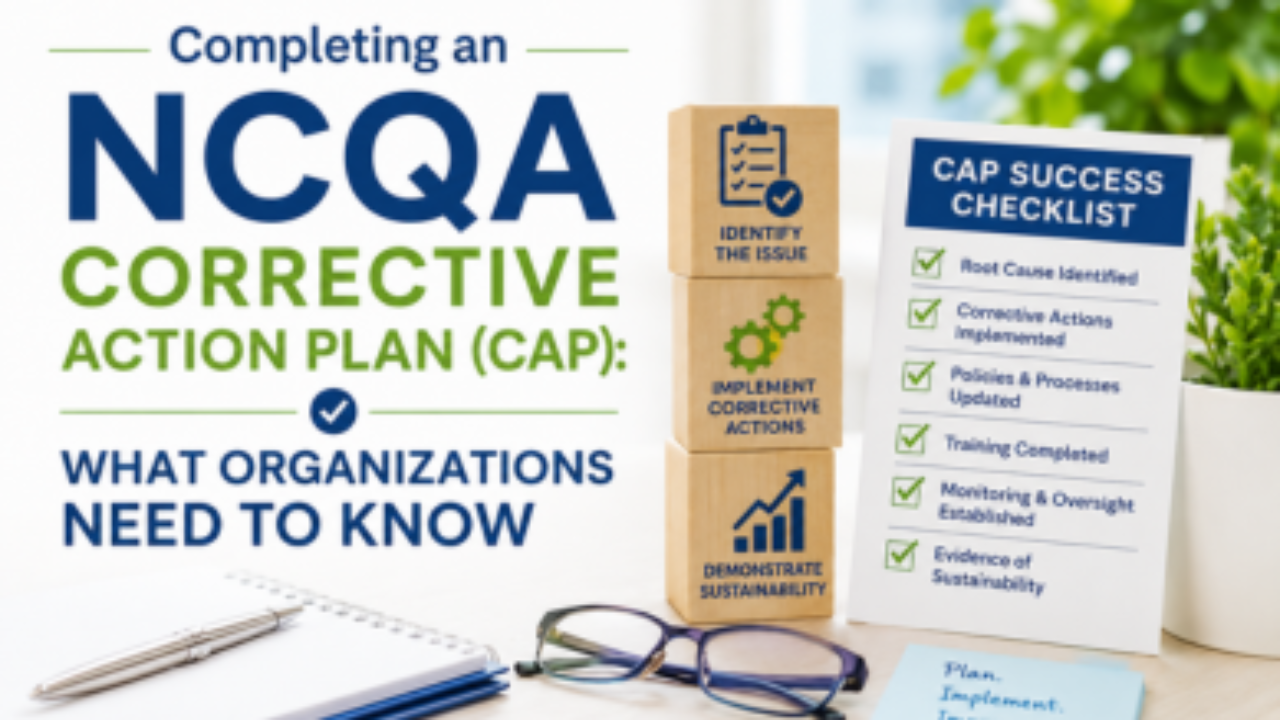
Successful CAP completion requires organizations to focus on root cause analysis rather than surface-level corrections. Strong CAP submissions clearly explain:
- The root cause of the issue.
- The corrective action implemented.
- The implementation timeline.
- Oversight and monitoring activities.
- Evidence demonstrating operational compliance and sustainability.
Organizations should also avoid overwhelming surveyors with excessive documentation that lacks a clear narrative. The strongest CAP submissions are concise, organized, and directly tied to the identified deficiency and applicable NCQA requirements.
Ultimately, organizations that approach CAPs strategically—not defensively—often emerge operationally stronger. A well-executed CAP demonstrates leadership engagement, organizational accountability, and the ability to sustain compliance beyond the accreditation survey itself. In many cases, the CAP process becomes a catalyst for stronger governance, improved operational consistency, and reduced accreditation risk in future survey cycles.
What to expect with a CAP Survey
- All activities to correct must be implemented in the six-month timeframe from the CAP submission to the survey.
- There are only four weeks from the time of the submission of documents until the closing conference.
- A conference call can be held if questions about the organization passing the requirements.
- There is no Preliminary Report stage.
- For file review, a minimum of 8 files is required.
- There is no CAP Survey process for Interrater reliability issues, only a Plan.
MHR has been involved with organizations who have a CAP in these situations:
- They started working with MHR when crucial lookback periods for documentation have not been met and/or 12-month look-back periods to correct errors for must-pass elements in file reviews are not met.
- We were working with organizations who were told by the consultants that corrections needed to be made (particularly for Information Systems Integrity) but could not obtain buy-in from departments and support from leadership to make sure they occurred early enough to pass that requirement.
DO:
- Review the Element and the surveyor’s comments when developing the CAP Plan so you are focused on what was missed and develop your Plan around that.
- Be very straightforward and specific for how you will mitigate this gap. Only provide information specific to the gap.
- If the CAP was based on must-pass file requirements (denials, appeals, credentialing and recredentialing), focus on sample file reviews. If retraining is required, make sure those completing the files understand requirements. Best practice? Start as soon as the surveyors complete the survey and virtually “walk out the door.” You will have a head start on the Plan submitted to NCQA.
- Obtain leadership support as early in the process as possible. You know it will take more resources.
DON’T
- Try to snow the surveyors with smoke and mirrors. They are experienced and can see through that. Too many documents that are not clearly related to the gap in question will annoy and frustrate the surveyor. You don’t want a frustrated surveyor!
- Wait until the last minute to get started on the Plan and implementing it. Changes, especially for those who process files, can take more time than you think. Habit pulls strongly against change, takes more mental work, and complying is not the primary focus of those that do the work every day.
It is important to identify the right levers for change and the right activities to implement. MHR consultants have a great deal of experience in their organizations prior to coming to MHR and can assist you to position the organization when a CAP is identified as likely to occur.
Don't navigate the CAP process alone. If your organization has received a Corrective Action Plan, MHR's consultants can help you identify priorities, strengthen your response, and prepare for a successful CAP Survey. Schedule a discovery call today or contact us at [email protected].
The 2023 and 2026 NCQA CAP process used to develop this blog.
Copyright © 2026 Managed Healthcare Resources, Inc. All Rights Reserved.


