Compliance vs. Quality Improvement: Why Understanding the Difference Matters in Managed Health Care Accreditation
Sep 07, 2026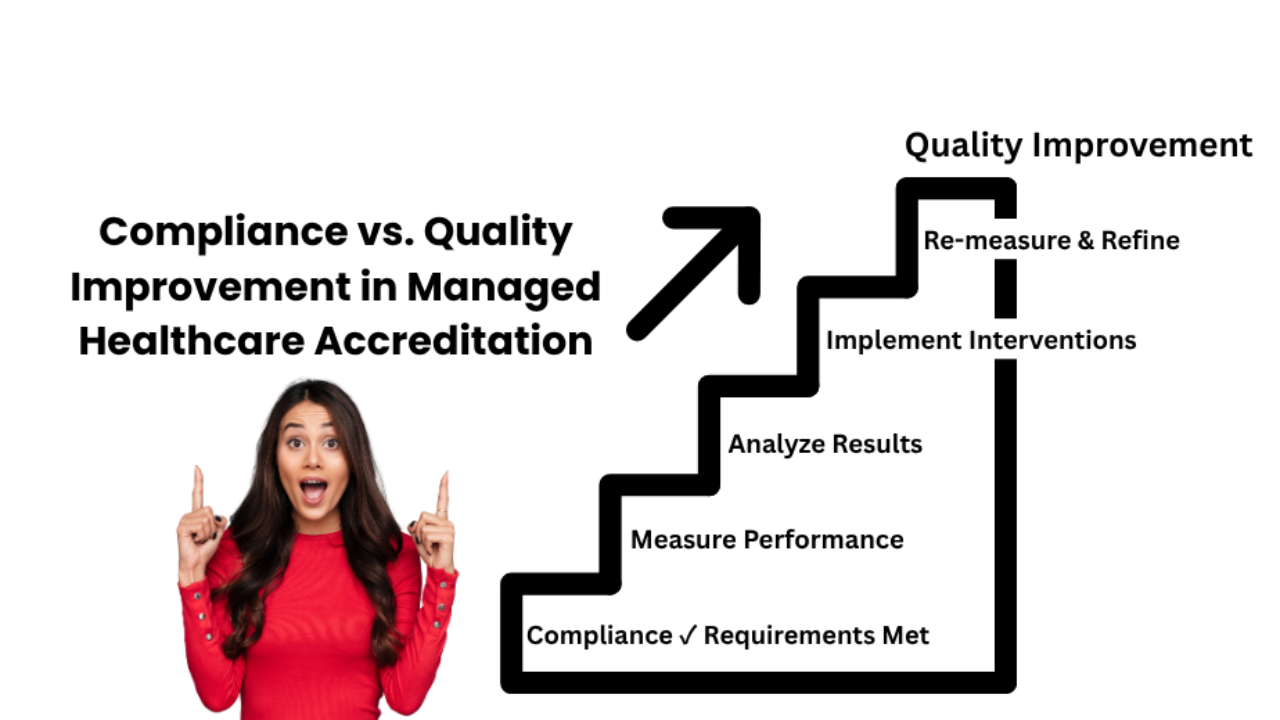
For many healthcare organizations, the words compliance and quality improvement (QI) are used almost interchangeably.
They shouldn’t be.
While both are essential to organizational success—and both are evaluated during accreditation—they serve fundamentally different purposes. Organizations that fail to distinguish between them often struggle during NCQA and URAC accreditation because they focus heavily on proving compliance while overlooking the continuous improvement culture that accreditation organizations expect.
Understanding the distinction is one of the keys to achieving not only accreditation success but also long-term operational excellence.
Compliance: Meeting the Requirements
Compliance answers one simple question:
“Did we do what was required?”
Compliance is about adhering to laws, regulations, contractual obligations, accreditation standards, and internal policies.
Examples include:
- Completing credentialing within required timeframes
- Sending adverse determination notices with all required language
- Maintaining documented policies and procedures
- Conducting annual committee meetings
- Completing required staff training
- Following approved workflows
Compliance is largely binary.
Either:
- The requirement was met, or
- It was not.
From an accreditation perspective, compliance is the foundation. Without it, organizations can lose points, receive Corrective Action Plans (CAPs), or fail must-pass elements.
However, compliance alone does not demonstrate excellence.
It simply demonstrates that minimum expectations were met.
Quality Improvement: Making Things Better
Quality Improvement asks a very different question:
“How can we improve performance?”
Rather than checking whether a process occurred, QI evaluates whether the process produces the desired outcomes—and if not, how to improve it.
Quality improvement is:
- Data driven
- Continuous
- Analytical
- Proactive
- Focused on measurable outcomes
Examples include:
- Reducing appeal turnaround times
- Improving member satisfaction
- Increasing preventive screening rates
- Decreasing provider credentialing turnaround time
- Reducing hospital readmissions
- Improving care management engagement
These are examples but they are not SMART goals. You really can’t measure “reducing.” By how much? That is a common mistake that organizations make.
QI is never “finished.”
Once one goal is achieved, the organization identifies the next opportunity for improvement. It may be a further reduction by X or it may be placing that metric on a monitoring status and choosing another opportunity for improvement.
That continuous cycle is what accreditation organizations expect to see.
A Simple Analogy
Think of driving a car.
Compliance means:
- You obey the speed limit.
- You stop at red lights.
- You wear your seatbelt.
Quality improvement means:
- Finding better routes.
- Reducing fuel consumption.
- Improving driving habits.
- Preventing future accidents.
Compliance keeps you legal.
Quality improvement makes you better.
Healthcare organizations need both.
Why Organizations Often Confuse the Two
Many organizations naturally prioritize compliance because compliance failures have immediate consequences, including financial penalties or reputational risk.
Missing a required notice. Missing a committee meeting. Failing to document credentialing.
These are visible deficiencies.
Quality improvement, however, requires a different mindset.
It requires organizations to ask:
- Are we achieving the outcomes we intended?
- Are our interventions actually working?
- What does our data tell us?
- What should we change next?
That requires leadership, analytics, collaboration, and organizational curiosity. QI is not one person sitting in a cubicle making up metrics and solely reviewing them periodically. It’s a team effort with varied experiences represented.
How NCQA and URAC View the Difference
Both NCQA and URAC expect organizations to demonstrate compliance with their standards.
However, accreditation is increasingly designed to evaluate whether organizations have mature systems for improving performance—not simply documenting it.
Surveyors frequently look for evidence that organizations:
- Measure performance
- Analyze trends
- Identify root causes
- Implement interventions
- Re-measure results
- Adjust strategies when improvements are not achieved
In other words:
Compliance gets you into the game.
Quality improvement demonstrates organizational maturity.
The Most Common Accreditation Mistake
One of the most common issues consultants encounter is organizations presenting evidence that demonstrates compliance while believing it also proves quality improvement.
For example:
Compliance Example
“Our committee met quarterly.”
That demonstrates compliance.
It does not demonstrate quality improvement.
A QI example would include:
- Performance data reviewed
- SMART goals established
- Root cause analysis performed
- Improvement interventions implemented
- Results measured over time
- Decisions adjusted based on findings
That tells the story of improvement.
Surveyors are looking for that story.
Quality Improvement Is More Than Monitoring
Another common misconception is believing that collecting data alone qualifies as quality improvement.
Monitoring is important.
Dashboards are important.
Reports are important.
But monitoring by itself is not improvement.
Organizations must demonstrate that they:
- Evaluated the findings
- Identified opportunities
- Took action
- Measured whether the action worked
Without action, monitoring is simply observation.
A Practical Example
Imagine member complaints regarding appointment availability have increased.
A compliance response might be:
“The complaints were logged and reported to the committee.”
That satisfies the reporting requirement.
A quality improvement response would go further:
- Analyze complaint trends.
- Identify affected provider groups.
- Determine root causes.
- Develop interventions.
- Educate providers.
- Monitor appointment access monthly.
- Measure whether complaints decrease.
- Modify interventions if improvement is insufficient.
One satisfies a requirement.
The other improves care.
Why This Difference Matters Financially
Organizations often think of accreditation as a pass/fail exercise.
In reality, organizations with strong quality improvement programs often experience broader operational benefits, including:
- Higher member satisfaction
- Better provider relationships
- Improved regulatory readiness
- More efficient operations
- Reduced rework
- Better documentation
- Stronger committee effectiveness
- Greater readiness for future accreditation cycles
Quality improvement frequently produces operational efficiencies that extend well beyond accreditation.
Building a Culture of Improvement
Organizations with successful accreditation programs tend to share several characteristics.
They:
- View accreditation as an ongoing management system—not a project.
- Use performance data to drive decisions.
- Encourage staff to identify improvement opportunities.
- Celebrate measurable improvements.
- Integrate QI into everyday operations.
- Learn from deficiencies instead of merely correcting them.
That culture cannot be created a few months before survey submission.
It develops over time.
The Bottom Line
Compliance is essential.
Without compliance, organizations cannot achieve accreditation.
But compliance represents the starting point—not the destination.
Quality improvement is what transforms accreditation from a documentation exercise into a strategic advantage.
The strongest organizations don’t ask only, “Did we meet the requirement?”
They also ask,
“How can we make this process better for our members, providers, and organization?”
That question is the foundation of lasting accreditation success.
How Managed Healthcare Resources Helps
At Managed Healthcare Resources (MHR), we help organizations achieve more than accreditation. We help them build sustainable foundations that integrate compliance with continuous quality improvement. Our consultants work alongside clients to identify operational gaps, strengthen governance, develop meaningful quality improvement initiatives, and create processes that support success long after the survey is complete.
Because accreditation isn't simply about proving you met today's standards. It's about building an organization that performs better tomorrow.
Turn Compliance into Continuous Improvement
Understanding the difference between compliance and quality improvement is only the first step. MHR's Quality Management & Improvement Training helps organizations develop measurable goals, perform meaningful analyses, and build sustainable quality improvement programs that support long-term accreditation success. The training specifically addresses the role of Quality Improvement Committees and how information, reporting, and improvement activities flow throughout the organization.
Learn More About Quality Management & Improvement Training
Need a Better Way to Manage Quality Improvement Activities?
MHR's quality improvement resources help organizations move beyond monitoring and into meaningful action. Our QI Work Plan Calendar Template: helps organizations track committee activities, issues, objectives, and areas of focus throughout the year, creating a structured approach to ongoing quality improvement efforts.
In addition, MHR offers quality improvement tools and templates designed to support performance measurement, improvement planning, and documentation of quality initiatives. These resources help organizations establish SMART goals, track progress, and demonstrate the continuous improvement processes expected during NCQA surveys.
Explore MHR Quality Improvement Tools & Templates:
Ready to move beyond compliance and build a culture of continuous improvement?
MHR helps organizations strengthen quality improvement programs, align accreditation activities with strategic goals, and create measurable performance improvements that last beyond the survey cycle.
Schedule a Discovery Call or contact [email protected] to discuss your organization's accreditation and quality improvement priorities.
Copyright © 2026 Managed Healthcare Resources, Inc. All Rights Reserved.


