How to Document Oversight, Metrics, and Improvement Activities for PMI 1 and PMI 2
Estimated read time: 5 minutes
Let’s be honest: when it comes to URAC accreditation preparation, Quality Management Committee minutes are one of the most underestimated pieces of documentation your organization produces. We see it all the time. Organizations put tremendous energy into their quality programs—monitoring metrics, launching improvement initiatives, analyzing trends—and then document it all with minutes that say something like, “metrics were reviewed” or “discussion occurred.”
That’s not oversight. That’s a placeholder.
Here’s the thing: during a URAC Desktop Review and Validation Review, your committee minutes serve as primary documentary evidence that your quality governance structure is functioning as intended. Vague minutes don’t just fail to impress URAC reviewers—they leave your organization vulnerable to findings that could have been easily avoided.
Under URAC Standard PMI 1: Quality Management Scope and URAC Standard PMI 2-1: Data Collection and Evaluation, organizations must demonstrate that quality performance is not only measured—but actively reviewed, discussed, and acted upon by a designated quality oversight body.
Your minutes are how you prove that’s happening.
Below is a practical guide to what URAC reviewers actually expect to see—and how to make sure your minutes tell the right story.
1. Evidence of the Quality Oversight Structure
Because PMI 1 requires that the quality management program be overseen by a quality oversight body, your minutes must clearly establish that this body exists, meets regularly, and operates with defined responsibilities. This sounds straightforward—but you’d be surprised how often the basics are missing.
Key elements to include in your minutes:
• Committee name (e.g., Quality Management Committee, Quality Oversight Committee)
• Meeting date and time
• Attendance and quorum documentation
• Identification of the chairperson and key participants
• A statement confirming the committee’s responsibility for oversight of the quality management program
• Approval of prior meeting minutes
Why this matters:
URAC reviewers need to confirm a formal governance structure exists and is consistently functioning. Your minutes are the evidence trail. If the structure isn’t visible in the minutes, it might as well not exist from a compliance standpoint.
2. Documentation of Metrics and Quantifiable Goals
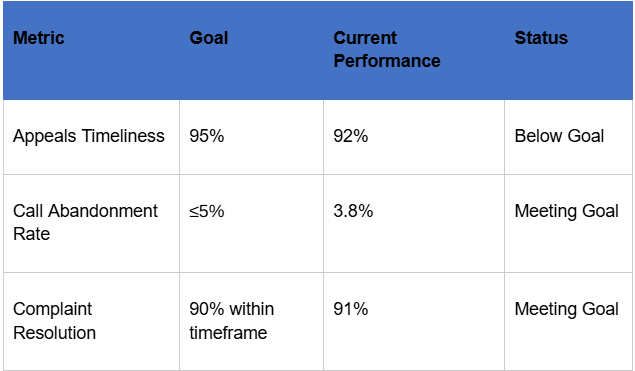
PMI 1 requires the organization to identify metrics and quantifiable goals relevant to the quality program. This means your minutes should reflect not just which metrics are on the agenda—but what the targets are and how current performance compares.
Minutes should include:
• The specific metric being reviewed
• The quantifiable goal for that metric
• Current reporting period performance
• Baseline or historical performance, when applicable
Here’s an example of how that documentation might look within the minutes:
Why this matters:
URAC requires quantifiable goals—not aspirational language, not general impressions. Your minutes must show that leadership is actively reviewing those goals and comparing them against real performance results. If the targets aren’t documented alongside the data, reviewers have no basis for evaluating whether your organization is meeting its own standards.
3. Evidence of Monitoring Progress Toward Goals
PMI 2 requires organizations to monitor progress toward quantifiable goals over time—not just conduct a one-time review of data. This distinction matters. Your minutes should show performance monitoring as an ongoing practice, not an annual event.
Minutes should include:
• Trend reports or summaries of prior performance periods
• Identification of improving, stable, or declining performance
• Discussion of whether goals are being met
Example narrative in minutes:
“The committee reviewed quarterly performance for Appeals Timeliness. Performance declined from 95% in Q2 to 92% in Q3, falling below the established goal of 95%. The committee requested further analysis of root causes contributing to the decline.” A subsequent follow-up must occur to reflect that relevant staff reviewed root causes—for example, insufficient staffing for high volumes over the year due to policy changes for payment of GLP-1s, which doubled the annual volume without a corresponding increase in processing staff.
That level of detail is what demonstrates active monitoring and evaluation of performance trends—and that’s exactly what PMI 2 is looking for.
4. Evidence of Data Analysis and Trend Identification
URAC expects organizations to analyze data and identify trends at least annually. This means your minutes should capture the interpretation of performance data—not just the presentation of numbers. There’s a meaningful difference between “here are our numbers” and “here’s what our numbers mean and why.” It reminds me of what I heard in a presentation years ago re: data reporting vs analysis: “Data, data everywhere but no information in sight.”
Minutes should capture discussion such as:
• Root cause analysis
• Contributing operational factors
• External influences affecting performance
• Identification of emerging risks
Example:
“Trend analysis of complaint categories shows a 30% increase in complaints related to provider directory accuracy. The committee determined that the increase coincided with recent network expansion into a new county—a 30% increase in practitioners over the previous network.” The committee directed the provider relations team to review data validation processes, establish a timeframe for completing those validations, and implement a more efficient update process. They also recommended increased member communication about network changes to manage expectations.
This demonstrates that the organization is evaluating performance results and identifying real opportunities for improvement—not just logging that a conversation happened.
5. Documentation of Quality Improvement Activities
PMI 2 requires organizations to design and implement improvement activities when performance indicates the need. So when your data shows a gap, your minutes need to show what the committee decided to do about it—specifically and with accountability.
Minutes should include:
• Identification of the performance gap
• Improvement strategy approved by the committee
• Responsible department or individual
• Timeline for implementation
• Plan for monitoring effectiveness
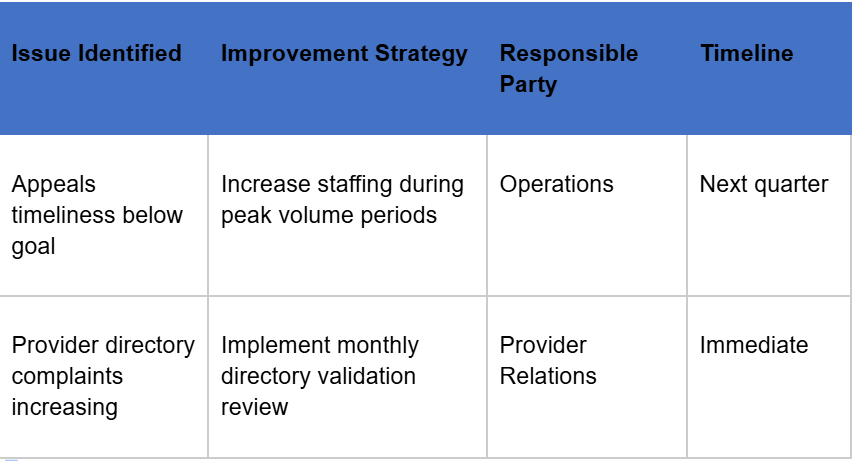
Reviewers are looking for evidence that the committee is not only reviewing data but also directing improvement activities. If the minutes show that issues were identified but no action was assigned, that’s a gap—full stop.
6. Follow-Up and Evaluation of Improvement Strategies
URAC standards emphasize ongoing measurement and evaluation of improvement activities. Your minutes should show follow-up on previously approved initiatives—not just approvals that disappear into a file folder and are never referenced again.
Examples include:
• Status updates on active improvement projects
• Revised strategies when initial interventions were ineffective
• Measurement of post-intervention performance
Example narrative:
“The committee reviewed the improvement plan implemented last quarter to address Appeals Timeliness. Following the staffing adjustments, performance increased to 96%, exceeding the target goal. The committee voted to continue the staffing model for the next reporting cycle.”
This kind of documentation demonstrates continuous quality improvement and governance accountability—which is precisely what URAC is designed to evaluate.
7. Evidence That the Committee Is Overseeing the Entire Quality Program
Finally, your minutes should reflect the committee’s broader oversight responsibilities—not just individual metrics in isolation. URAC reviewers want to confirm that the quality oversight body is functioning as the central governance mechanism for quality performance across the organization.
Minutes should also reflect:
• Review of the annual quality program evaluation
• Approval of quality work plans
• Review of regulatory or accreditation-related performance metrics
• Escalation of issues to executive leadership when necessary
Practical Tips for URAC-Ready Committee Minutes
After working through URAC preparation with many organizations, here’s what we consistently see separating strong minutes from weak ones.
Make sure yours:
• Clearly identify metrics and quantifiable goals
• Document performance monitoring and trend analysis
• Capture discussion and interpretation of data—not just data presentation
• Record decisions and improvement actions with assigned owners and timelines
• Include follow-up on prior initiatives
Your minutes should tell a clear, connected story of oversight, accountability, and continuous improvement. If someone unfamiliar with your organization picked up those minutes, could they understand what was monitored, what was found, what was decided, and what happened next? If the answer is yes, you’re in good shape.
The Bottom Line
Quality Management Committee minutes are more than administrative documentation—they are critical evidence of organizational governance and performance oversight. Well-structured minutes demonstrate that leadership is actively reviewing quality data, monitoring progress toward measurable goals, and implementing improvement strategies when performance falls short.
Organizations that approach minutes as a strategic quality management tool—not simply a record of attendance—are far better positioned to demonstrate compliance and succeed during URAC accreditation reviews.
If your minutes aren’t telling that story yet, now is the time to fix it—before a URAC reviewer tells you.
MHR Can Help
Preparing for URAC accreditation requires the right tools, the right training, and consultants who understand URAC from the inside out. MHR’s team includes former URAC reviewers who audited for URAC recently instead of several years ago with hundreds of reviews under their belts—giving your organization an unmatched depth of accreditation expertise.
• Training: Schedule training with MHR on URAC quality management standards, customized to your organization’s needs. Learn more about training here: https://www.managedhealthcareresources.com/NCQA-training-products
• Tools and Templates: MHR’s tools and templates support compliant documentation of committee minutes, performance metrics, and improvement activities. Discover Tools & Template options here: https://www.managedhealthcareresources.com/tools
• Consulting: Work directly with MHR’s URAC-experienced consultants to close documentation gaps before your review. Schedule a Discovery Call: https://zc.vg/2wWmh
Learn more at managedhealthcareresources.com and follow us on LinkedIn for updates.
Copyright © 2026 Managed Healthcare Resources, Inc. All Rights Reserved.


