Organizations often believe accreditation risk begins six months before survey submission.
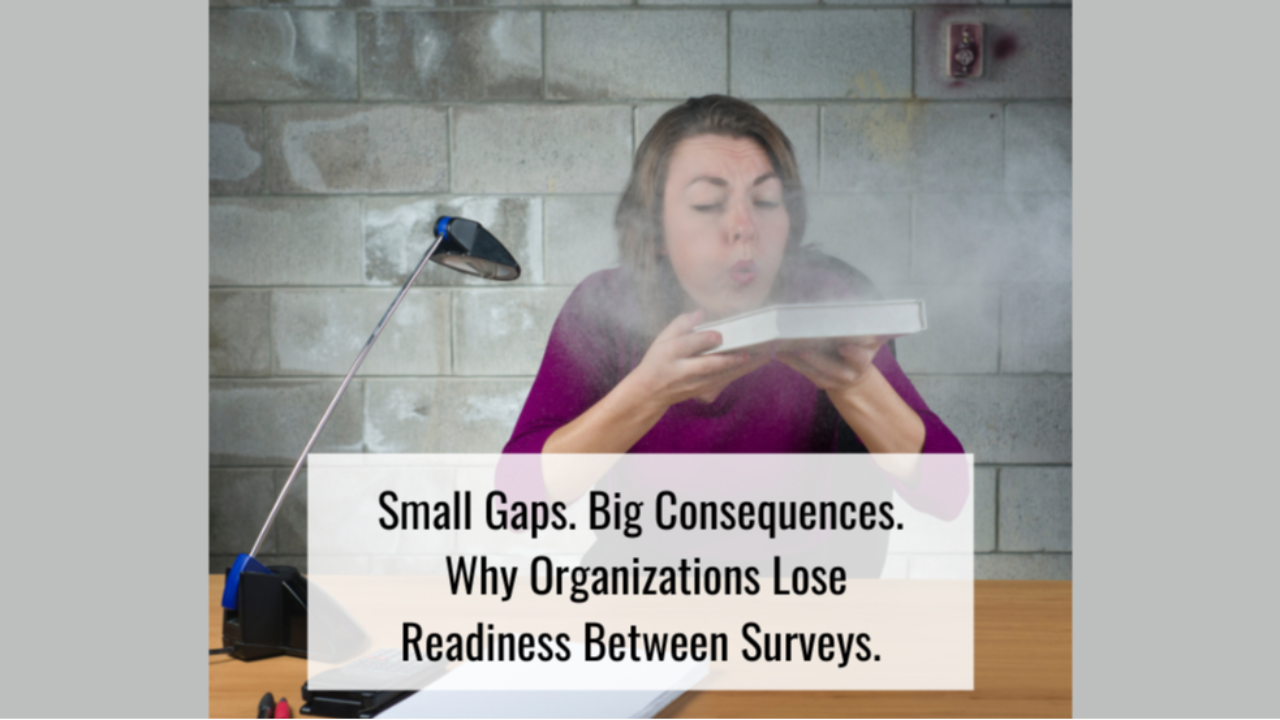
In reality, the greatest accreditation risks usually begin the moment the last survey ends.
Many organizations experience what can best be described as “accreditation drift.” Processes that were tightly managed during survey preparation gradually loosen. Documentation practices become inconsistent. Staff turnover erodes institutional knowledge. Operational teams return focus to competing priorities. By the time the next survey cycle approaches, organizations are often forced into a costly and disruptive scramble to reconstruct evidence and remediate avoidable deficiencies.
The challenge is not typically a lack of commitment.
The challenge is sustainment.
Accreditation Is a Continuous Operational Discipline
One of the most common misconceptions about accreditation is treating it as a periodic project rather than an embedded operational framework.
Accreditation standards involve:
• Ongoing look-back periods
• Continuous monitoring requirements (i.e., throughout the look-back period requirements along with credentialing monitoring)
• Annual analyses
• Real-time documentation expectations
• Governance oversight (especially for Health Outcomes accreditation)
• File review consistency
These activities cannot be recreated retroactively with the same level of credibility or operational integrity. I call that “backfilling.”
Organizations that sustain readiness effectively tend to:
- Operationalize standards into workflows
- Conduct routine audits between cycles
- Monitor documentation quality continuously. I call this “Inspect what you expect.”
- Address small issues before they become systemic
- Maintain leadership visibility into accreditation risk
The Hidden Risk: Deficiencies That Were Never Cited
Another common mistake is assuming that if surveyors did not identify an issue, the issue no longer matters.
Strong accreditation programs recognize that uncited gaps may still represent operational vulnerabilities. Sometimes an issue is not sampled, such as in delegation agreements and the myriad of files not chosen for review. Sometimes documentation narrowly passes review. Sometimes variability exists that may create future exposure during the next look-back period. Especially as standards change and evolve, including the Explanation that has “must include” or “includes but not limited to” in the bullets. Even though the stem and factors may not change, the application and specifics may as organizations submit questions to Policy Clarification Support throughout the year.
Organizations that achieve stronger long-term outcomes typically address both:
- Surveyor-identified findings
- Internal operational risks identified during readiness reviews
That distinction often determines whether the next survey cycle becomes manageable—or chaotic.
Sustainment Reduces More Than Accreditation Risk
Organizations frequently underestimate the operational value of sustainment activities.
Strong sustainment programs often improve:
- Documentation consistency
- Committee oversight
- Workforce accountability
- Delegation management
- Staff onboarding
- Audit readiness
- Leadership visibility into operational risk
Sustainment is not simply about preserving accreditation status. It is about reducing organizational disruption, avoiding preventable remediation costs, and maintaining operational discipline over time.
The Organizations That Struggle Most
The organizations most vulnerable between cycles often share similar patterns:
- Heavy dependence on one accreditation leader – who may leave, move to a different department or advance to a higher level, or retire.
- Limited ongoing audit activity
- Inconsistent file review processes
- Delayed policy updates
- Reactive rather than proactive oversight
- Loss of institutional knowledge through turnover
These risks are rarely visible until the next survey preparation period begins.
By then, the look-back period may already contain deficiencies that cannot be fully corrected retroactively.
Final Thought
Organizations do not usually lose accreditation readiness overnight.
Readiness erodes gradually through small operational inconsistencies repeated over time.
The strongest accreditation programs are not the ones that prepare intensely every three years.
They are the ones that never truly stop preparing.
Supposedly Thomas Jefferson said, “Eternal vigilance is the price of liberty.” Early in my career in accreditation and quality I changed my guiding principle to, “Eternal vigilance is the price of quality.” Never stop preparing, auditing, and monitoring if you wish to have sustained accreditation to “stay prepared” and not “get prepared.”
- Are standards operationalized into daily workflows?
- Are audits occurring routinely between surveys?
- Is leadership receiving meaningful visibility into accreditation risk?
- Could a survey begin tomorrow without extensive preparation?
How Confident Are You in Your Accreditation Readiness?
If you are uncertain about any of these questions, schedule a Discovery Call with MHR. We will discuss your current accreditation sustainment approach, your concerns, and whether a comprehensive readiness assessment is the right next step.
Schedule Your Discovery Call or send us an email at [email protected]
Copyright © 2026 Managed Healthcare Resources, Inc. All Rights Reserved.


