An approved Model of Care (MOC) should not be viewed as a document that is submitted, approved and then put away until the next renewal. Special Needs Plans (SNPs) continue to evolve throughout the MOC approval period. Operational processes change, responsibilities shift, benefits may change, and State Medicaid Agency Contract (SMAC) requirements may be modified.
Some of those changes can have implications for the organization's approved MOC.
CMS regulations permit—and in certain circumstances require—SNPs to submit revisions to an approved MOC before the end of its approval period. NCQA reviews these off-cycle MOC submissions on behalf of CMS.
A strong MOC governance program should therefore include an ongoing process for identifying, evaluating and managing changes that could affect the approved MOC.
1. Identify Operational and SMAC Changes
The first step is having a mechanism for identifying changes before they are implemented.
Potential changes requiring MOC evaluation include:
- Health Risk Assessment (HRA) processes, including timing, staffing, outreach or use of results
- Individualized Care Plan (ICP) development and updates
- Interdisciplinary Care Team (ICT) composition or processes
- Risk stratification methodology
- Care transition protocols
- Target population or care management approaches
- Benefit package changes that could materially affect SNP operations or member well-being
- Authority or oversight for personnel performing care coordination
- Quality metrics used for performance measurement
- State Medicaid Agency Contract (SMAC) changes that affect processes described in the approved MOC
SMAC changes deserve particular attention for D-SNPs. A change to the SMAC does not automatically require an off-cycle MOC submission. However, it may trigger one when the SMAC change materially affects processes described in the approved MOC.
For example, a SMAC revision may affect care management or care transitions, ICP or ICT processes, enrollee eligibility categories, service areas, integration arrangements, or the coordination of Medicaid benefits such as LTSS or behavioral health.
⭐ MHR Recommendation: Make MOC impact assessment part of the organization's formal operational and regulatory change-management processes. The MOC team should be notified of potentially significant operational and SMAC changes before implementation—not after.
2. Determine Whether the Change Is Reportable
Not every MOC-related change requires an off-cycle submission.
Minor and administrative changes generally do not require submission. Examples include staff name changes, administrative staffing adjustments, named provider additions or deletions, demographic and quality-results updates, and non-substantive grammatical or formatting changes.
The same principle applies to SMAC changes. Administrative or technical contract amendments, supplemental benefits required by the SMAC, or clarifications of responsibilities that do not change how MOC processes are operationalized generally do not trigger an off-cycle submission.
The central question is:
Does this change materially alter what the organization told CMS and NCQA it would do in its approved Model of Care?
If the answer may be yes, the proposed change should move into formal MOC review.
3. Confirm Eligibility and Timing
Before preparing an off-cycle submission, determine whether the MOC and proposed change are eligible for review.
D-SNPs and I-SNPs may submit qualifying revisions during the designated off-cycle windows. C-SNPs are more limited and may submit an off-cycle revision only when CMS requires one to ensure compliance with applicable law.
The MOC also generally must have gone into effect before it is eligible for an off-cycle revision unless CMS approves the submission.
For CY 2027 and subsequent years, there are two annual off-cycle submission windows:
January 1–March 31
October 1–December 31
These defined windows make proactive MOC change management particularly important.
4. Conduct an MOC Impact Assessment
Once a potentially reportable change has been identified, determine everywhere that change affects the MOC—not simply the section where the operational process is primarily described.
Consider the entire chain:
Operational or SMAC Change → MOC Elements/Factors → Policies and Procedures → Workflows → Roles and Responsibilities → MOC Matrix → Related MOC Sections
Changes often have downstream effects. For example, a change in risk stratification methodology could affect not only the description of risk stratification but also care management intensity, ICP processes, ICT activities and monitoring.
Reviewing the MOC as an integrated operational model helps prevent inconsistencies within the submission.
5. Review Previous NCQA Findings
Before drafting revisions, retrieve the most recently approved MOC and NCQA feedback.
This step is particularly important because an off-cycle revision can create an additional obligation.
If the organization proposes changes to an element that previously contained a deficient factor, the off-cycle submission must also fully address that prior deficiency. If it does not, NCQA will determine the off-cycle submission to be Non-Acceptable.
Therefore, every off-cycle assessment should include the question:
Are we modifying an element that previously had a deficiency?
If so, addressing only the new operational change is not sufficient.
6. Consolidate Anticipated Changes
Before submitting, engage appropriate operational leaders and determine whether additional MOC-related changes are anticipated.
Rather than handling changes independently, organizations should consider whether multiple anticipated revisions can appropriately be incorporated into a single off-cycle submission.
This is another reason MOC oversight should be centralized. Operations, compliance, Medicaid, quality, care management and other departments should not independently change processes described in the MOC without considering the broader implications.
7. Prepare the Off-Cycle Submission
The most recently approved MOC must be used as the base document for the off-cycle revision.
The organization should identify exactly what changed and where those changes appear in the MOC. The MOC Matrix should also be updated so reviewers can readily trace revisions to the applicable requirements.
Revisions must be clearly identifiable through track changes or the formatting methodology specified by NCQA.
The goal should be to make three things readily apparent to the reviewer:
What changed?
Where did it change?
How does the revised process continue to satisfy the MOC requirements?
8. Obtain Internal Approval—but Do Not Implement Yet
There is an important distinction between approving a proposed operational change internally and implementing it.
SNPs may not implement proposed off-cycle MOC changes until NCQA has reviewed and approved them.
NCQA does not rescore the entire MOC during an off-cycle review. Instead, the submitted changes are determined to be either Acceptable or Non-Acceptable.
Until the revisions are determined Acceptable, the organization must continue operating under its currently approved MOC.
This makes the timing of operational and SMAC changes particularly important. A change should not move into implementation simply because internal leadership, a department or a vendor is ready to proceed.
9. Submit and Monitor the Review
Off-cycle submissions are uploaded through the Health Plan Management System (HPMS) during the applicable submission window.
Organizations should build the NCQA review period into their implementation plans. Operational leaders need to understand that submitting the revised MOC does not authorize implementation.
The organization should maintain the existing approved process until the revised MOC has been reviewed and determined Acceptable.
10. Manage a Cure, If Required
If NCQA determines that an off-cycle submission is Non-Acceptable, the SNP has one opportunity to submit corrected documentation during the submission window.
Importantly, the organization cannot implement the portions of the proposed submission that appeared to be acceptable while correcting another portion. The proposed revisions remain unapproved until the cure submission as a whole is determined Acceptable.
The organization must continue operating under the previously approved MOC during this period.
11. Implement and Operationalize the Approved Change
Once NCQA determines the off-cycle submission to be Acceptable, implementation can begin.
Implementation should extend well beyond updating the MOC document itself. Organizations should ensure alignment across:
MOC → Policies → Procedures → Workflows → Systems → Staff Training → Monitoring → Oversight
For a SMAC-related change, this may also require verification that Medicaid contractual requirements, MOC language and actual operational practices are aligned.
12. Return to Ongoing MOC Monitoring
NCQA approval completes the individual off-cycle change, but it does not end MOC oversight.
The organization should return to ongoing monitoring and periodically ask:
Has anything changed in how we operate compared with what our approved MOC says we do?
That question should become part of ongoing MOC governance.
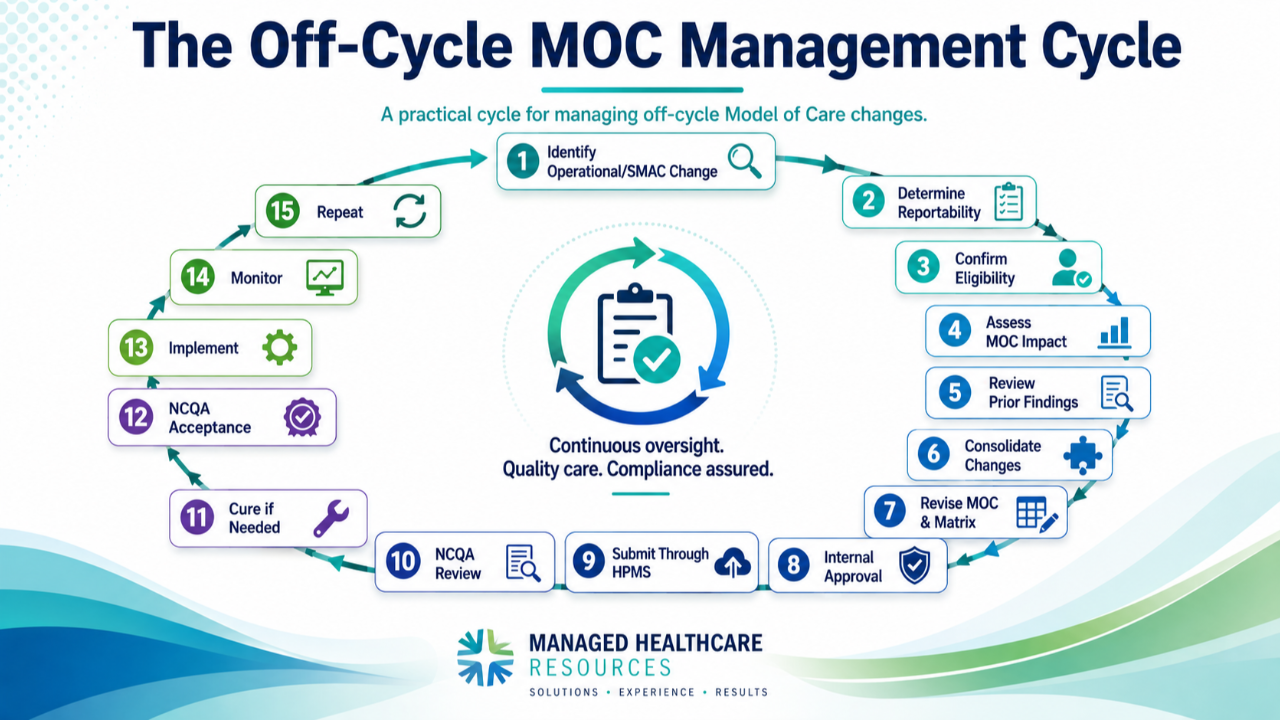
The Off-Cycle MOC Management Cycle
Identify Operational/SMAC Change → Determine Reportability → Confirm Eligibility → Assess MOC Impact → Review Prior Findings → Consolidate Changes → Revise MOC & Matrix → Internal Approval → Submit Through HPMS → NCQA Review → Cure if Needed → NCQA Acceptance → Implement → Monitor → Repeat
The underlying principle is straightforward: the approved MOC and actual SNP operations must remain aligned.
Organizations that treat the MOC as a living operational framework—not simply a document prepared for NCQA review—are better positioned to identify changes early, maintain alignment across departments and avoid discovering MOC inconsistencies after new processes have already been implemented.
MHR Can Help
Managed Healthcare Resources (MHR) can assist organizations with evaluating proposed MOC and SMAC changes, determining their impact on the approved Model of Care, reviewing prior deficiencies, preparing off-cycle revisions and supporting MOC readiness.
We are also pleased to announce that Malinda Sant, MBA, LMSW, CCM, FAHM, has been accepted as an MOC Surveyor for NCQA, beginning in fall 2026.
If your organization would like assistance with its Model of Care, off-cycle MOC revisions or MOC readiness, contact MHR at [email protected] or click here to schedule a call.
Source: NCQA, Off-Cycle Model of Care (MOC) Submission Guidance
Copyright © 2026 Managed Healthcare Resources, Inc. All Rights Reserved.


